
The design is in the details: What should national permanent CDR targets look like?
Every EU Member State will have residual emissions by 2040. That means every EU Member State needs permanent carbon dioxide removal (pCDR). So why does the 2040 framework have no dedicated target for it?
In May, we submitted a response to the European Commission’s consultation on the 2040 climate framework. A key question stood out: now that the EU has agreed to reduce net emissions by 90%, should separate sub-targets for emissions reductions, land sinks, and permanent carbon dioxide removal (pCDR) be introduced to reach the target at national level?
EU countries have had binding land sink obligations since the LULUCF Regulation came into force in 2018. But permanent CDR targets would be a first.
Back when the 2030 climate framework was designed, the permanent CDR sector was too novel to warrant a separate target. Ten years later, the sector seems ready for a real commitment.
But the novelty of the industry also poses a challenge: how can we reliably quantify and assign national pCDR targets to EU countries?
From target fatigue to target hunger
With the proposal for the upcoming climate framework expected in Q4 of this year, it’s not the first time the permanent CDR sector has called for a dedicated target. One of the main debates during the European Climate Law revision was whether the 2040 ambition should be expressed as a single net target or contain dedicated decarbonisation and carbon removal sub-targets. Some Member States opposed additional binding obligations, with the term “target fatigue” coming up repeatedly in discussions, so in the end a single target was adopted.
So why are we bringing pCDR targets again, especially since the EU Emissions Trading System (ETS) is already moving towards including some permanent CDR methods?
- The ETS doesn’t cover everyone. Hard-to-abate sectors like agriculture, some industrial processes, and parts of transport fall outside of the ETS scope, leaving a significant share of residual emissions with no obligation to fund permanent removals. Even with a well-designed CDR integration into the ETS, a demand gap is inevitable as emissions decline, meaning the ETS alone cannot deliver the CDR volumes the EU will need by 2050.
- Targets create ownership. Every Member State will have residual emissions and will therefore need to rely on permanent CDR to reach net-zero. National targets make that responsibility explicit and unavoidable.
- Targets encourage national action. Right now, only a handful of countries are exploring pCDR mandates. Given how long it takes to build CDR capacity, this is too slow to reach the volumes Europe will need. Binding targets would push every country to act – not just the frontrunners.
Splitting the check: how should pCDR targets be allocated?
The big challenge of setting national pCDR targets is that the EU would be starting from a near-zero baseline. Unlike emissions reductions, where countries can build on existing trajectories, pCDR requires developing entirely new capacity. This prerequisite makes the choice of allocation method all the more consequential.
The framework that makes most sense is capacity to act/ability to pay – the same logic used under the Effort Sharing Regulation, where countries with greater financial resources take on greater responsibility for emissions reductions. We measure this using Gross National Income (GNI) scaled by GNI per capita, a metric that reflects both the size of an economy and the wealth of its citizens.
Using this approach we drew on modelling we conducted with VTT Finland that estimated the volumes of pCDR needed to achieve the 2040 target to propose what an illustrative set of national pCDR targets could look like.
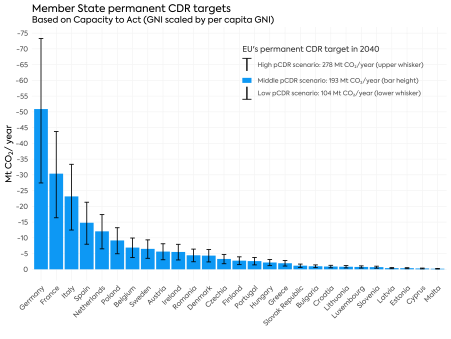
Figure 1: Hypothetical Member State pCDR targets based on allocating a total EU pCDR target to the individual Member States according to cumulative GHG emissions from 1990 (PRIMAP data set). A range (104-278 Mt CO2/year) for total EU is used, based on three modelled scenarios by VTT in partnership with Carbon Gap. The bar height indicates the scenario which results in an EU pCDR target of 193 Mt CO2, and upper and lower bounds are the whiskers reflecting the scenarios where EU total targets were 278 Mt CO2/year and 104 Mt CO2/year, respectively.
A note on the numbers: there’re currently no official EU-wide pCDR volume targets for 2040. The figures used here are indicative, drawn from our scenario modelling, and the actual volumes may shift – not least because up to 5% of the 90% target may now be met through international credits. The allocation logic matters more than the precise numbers at this stage.
Under the capacity to act approach, Europe’s largest economies take on the highest targets. Conversely, more than half of Member States may end up with targets below 5 Mt CO2 per year, potentially less depending on the overall 2040 volumes.
Capacity to act is not the only principle that could be operationalised. Historical emissions could be proposed as an alternative allocation principle. Interestingly, the two approaches produce broadly similar country rankings (See Figure 2). Germany, France, Italy, Spain and Poland consistently appear near the top under both scenarios.
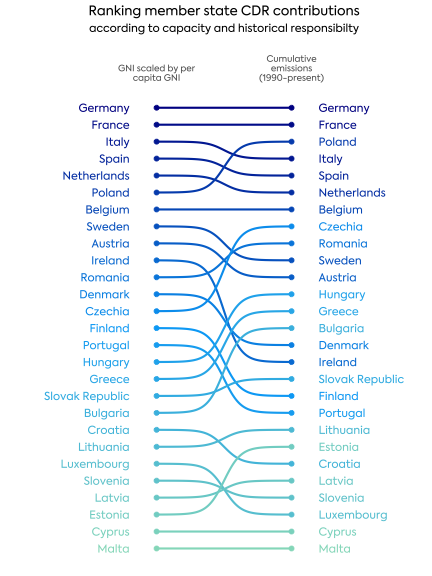
Figure 2: Member States’ ranking based on their GNI scaled by per capita GBI and cumulative emissions since 1990. Both rankings point to the same group of Member States as having the greatest responsibility to deliver permanent CDR. The GNI ranking is based on data from the World Bank – World Development Indicators for 2024. The cumulative emissions ranking is based on the PRIMAP historical emissions data.
A third possible basis is projected residual emissions – in principle, the most direct way to determine how much pCDR capacity each country needs. In practice, however, residual emissions projections across Member States vary too much at this stage to serve as a reliable allocation key. This may change in future review cycles.
Responsibility without borders?
Under the capacity to act logic, countries like Germany will carry high targets. Is that achievable in practice?
Based on Carbon Gap's Carbon Removal Readiness Assessment, Germany's estimated domestic pCDR potential by 2045 is 27 Mt CO2 per year – lower than the target it would receive under capacity-based allocation. Other countries near the top of the list face similar constraints. Meanwhile, some countries with lower financial capacity happen to have favourable geology for CO2 storage, access to renewable electricity, or abundant biomass – precisely the conditions that make permanent CDR delivery cost-effective.
The solution, however, is not to reassign responsibility to wherever the geology is good. That would concentrate obligations in a small number of countries based on natural endowments rather than fairness and financial capacity. Such allocation would be politically unworkable. Instead, the solution is to separate CDR responsibility from CDR delivery.
Responsibility follows financial capacity. Delivery follows cost-effectiveness. A country that bears a high obligation should be able to meet a share of it by investing in CDR projects elsewhere in the EU, where the infrastructure conditions make deployment faster and cheaper.
From targets to policy design
If responsibility and delivery can be decoupled, Member States need concrete ways to access CDR outcomes beyond their borders. Two main mechanisms are on the table:
Project-based cooperation means a Member State co-finances a pCDR facility in another country, and agrees in advance how the resulting removals count towards the targets. This is the better option for the near-term; it channels investment into new capacity before it exists, gives project developers funding certainty, and builds the infrastructure clusters that will underpin pCDR at scale.
Credit trading – purchasing already delivered pCDR units – is more flexible, but if it becomes the primary route, it could create a system where countries wait to buy outcomes rather than helping to build them. To deliver the required volumes by 2040, pCDR projects need early investments, so trading should come complementary to cooperation.
This kind of cross-border cooperation can create genuine mutual benefit for the Member States. A country with high financial capacity but limited domestic CDR potential can direct investment into a project in a country with favourable geology or grid conditions. In doing so, it would export the engineering expertise and supply chain know-how that its domestic industry has developed. The host country, in turn, gains capital, infrastructure, and a share of the removals counting toward its own target proportional to its co-investment. Both countries build ownership of the outcome and spread industrial and economic benefits across Europe
EU-level procurement will play an important role, kick-starting the market where commercial investment has not yet arrived and acting as a safety net if national delivery falls short. Irrespective of these functions, national accountability must remain at the center of pCDR delivery in the 2030-2040 decade.
Where does this leave us?
The case for national pCDR targets is straightforward: every Member State will have residual emissions, and voluntary action alone will not get Europe to net-zero. The harder question is design. Responsibility should follow financial capacity while delivery should follow cost-effectiveness, with cross-border cooperation directing investment to where CDR can be built most feasibly. Getting these choices right will matter as much as the headline numbers themselves.