
ArticleNational spotlights
Beyond emissions cuts: Italy's carbon removal opportunity
Italy has a net-zero target but no carbon removal strategy. This blog builds on Italy's CRRA report to show what's at stake - and what needs to change.
Italy, as several other countries analysed with the Carbon Removal Readiness Assessment, has an issue: it has a net-zero target, it is cutting emissions, and it is planning for CCS, but the carbon removal part of the net-zero story is missing. For a country facing 68-100 MtCO₂ of projected residual emissions by 2050, that gap matters – and the natural sink is not going to close it alone.
Carbon removals are becoming an essential pillar of Europe's path to climate neutrality. Yet Italy, the EU's third largest economy, is falling behind. It lacks the policy architecture, governance structures, and market incentives needed to deliver removals at scale. The Carbon Removal Readiness Assessment (CRRA) for Italy is clear: the country has significant carbon removal potential by 2050, but the window to act is narrowing. Italy will need to adapt existing policies and create new ones to successfully support a portfolio of removal approaches while ensuring environmental integrity and public trust.
Three illustrative pathways: the good, the (not too) bad, and the ugly
As in other CRRAs, the Italy report sets out three illustrative pathways at different ambition levels. These are not forecasts, and their assumptions vary widely, but together they give a good grasp of what it takes to achieve different CDR potentials based on the national resources and social context.
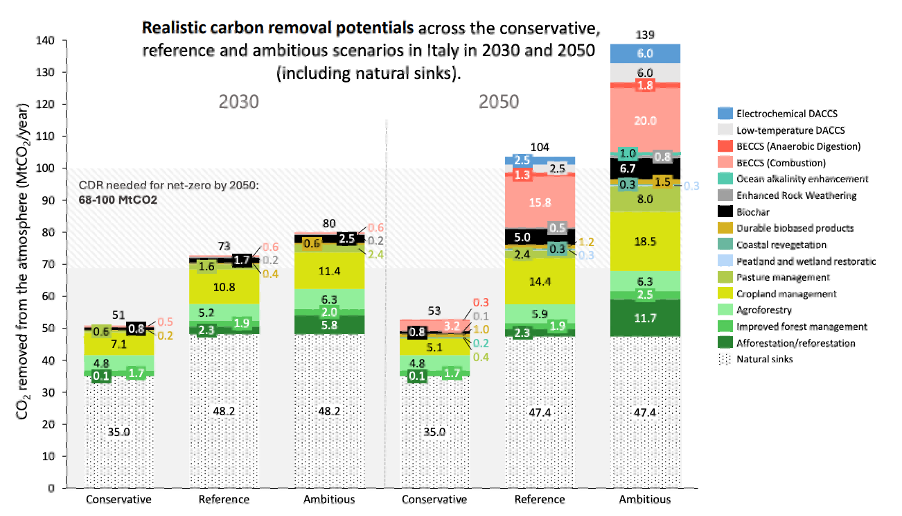
The ugly. In the Conservative scenario, permitting drags, incentives stay thin, and public scepticism toward less mature methods goes unanswered. Engineered CDR limps along at 18 MtCO₂/year. Add the natural sink - forests and soils - and the country tops out near 53 MtCO₂/year, leaving residual emissions above 50 MtCO₂/year, well past mid-century. Net-zero stays out of reach.
The (not too bad) Reference scenario does the homework. The National Integrated Energy and Climate Plan 2024 is implemented coherently, the Long-Term Strategy is taken seriously, the EU's Carbon Removal Certification Framework is wired into national law, and MRV systems are streamlined. Engineered CDR delivers roughly 56 MtCO₂/year, the natural sink adds 47, and the total - about 104 MtCO₂/year - finally covers the residual emissions. Net-zero becomes possible.
The good (aka Ambitious) scenario plays the full hand. Storage sites beyond the current Ravenna project come online, biomass plants are fitted with capture, and carbon farming becomes a routine line on a CAP application. The portfolio reaches more than 91 MtCO₂/year, and with the natural sink the country approaches 140 MtCO₂/year - overshooting residuals and opening a route to 40-70 MtCO₂/year of net-negative emissions. That is the territory Europe needs after 2050 if a temperature overshoot is to be reversed.
Same country, same natural resources, different policies - three very different climate outcomes.
A key missing ingredient: demand
If Italy has the technical potential, why is deployment still so limited? At Carbon Gap's launch event in Rome, participants returned again and again to one issue: demand. Without reliable demand signals, removal markets cannot mature, investors hesitate, projects struggle to finance, and innovation slows. The role of public policy at both the national and European level was seen as key. That means long-term market certainty through public procurement mechanisms, integrating removals into the national climate strategy, and clear certification standards to ensure environmental integrity, robust MRV and public trust.
A national strategy to create an enabling environment
The deeper issue is that Italy has no national CDR strategy and no coherent enabling environment around it. With 15 removal methods feasible, the country could build a genuinely diversified portfolio that strengthens rural economies, supports industrial innovation, and creates skilled jobs. But potential is not policy. Without a strategic framework that clarifies how removals fit within Italy's wider decarbonisation agenda, the sector will stay stuck in its early stages.
From assessment to action
Following the launch of Italy’s CRRA report, Carbon Gap and the Rete Italiana Rimozione Carbonio (RIRC), Italy's recently launched CDR association, co-hosted the country's first CDR road-mapping workshop. More than 20 participants began turning the barriers identified in the CRRA into the foundations of a practical, nationally grounded strategy.
Working through the regulatory, market, and social acceptability barriers showed just how much needs to happen, and how many actors need to move together. Connecting that ecosystem, building a shared voice, advocating for the demand-side policy Italy lacks, and ensuring CDR is deployed fairly is essential. And none of it works without public trust: carbon removals cannot scale sustainably without clear local benefits, credible oversight, and genuine community engagement - especially in Italy, where regional identities and local governance shape infrastructure and land-use decisions.
Italy still has time to build a carbon removal sector worthy of its net-zero ambitions, but time is a resource that keeps shrinking. The race to net-zero is no longer only about cutting emissions; it is about building the systems that remove carbon permanently, responsibly, and at scale. What Italy decides now will determine whether it helps shape Europe's carbon removal future or spends the next decades catching up.
By Martina Massei.