Three Paths to Net-Zero and Beyond: Finland’s Race Against the Carbon Clock
Finland has made great progress in its climate action, but our recent Roadmap for Finland to become carbon neutral points to three different pathways: business as usual, nature-first, and the technology trail.
On a crisp November morning in Helsinki, anticipation fills the Lantern Hall. Finland – a nation celebrated for its vast forests, sauna traditions, and, for climate insiders, its bold ambitions – is about to hear the results of a study that could shape its future.
The year is 2025, and the clock is ticking. By 2035, Finland has pledged to reach carbon neutrality, one of Europe’s – and the world’s – most ambitious climate targets. Yet projections reveal that a gap of 16–19 million tonnes of CO2 stands between the country and its promise. Without decisive action, neutrality risks slipping away.
Enter Carbon Gap and Sweco Finland with their Carbon Removal Readiness Assessment report and roadmap. After months of examining forests, industries, and communities, they pose the pressing question: “Can Finland remove enough carbon to close this gap? And if so, how?” They are joined by experts and key stakeholders to discuss results and how to unlock the carbon removal potential of the country.
Three illustrative futures: business as usual, nature-first, and the technology trail
The report sketches three potential scenarios that illustrate the trade-offs Finland must weigh today.
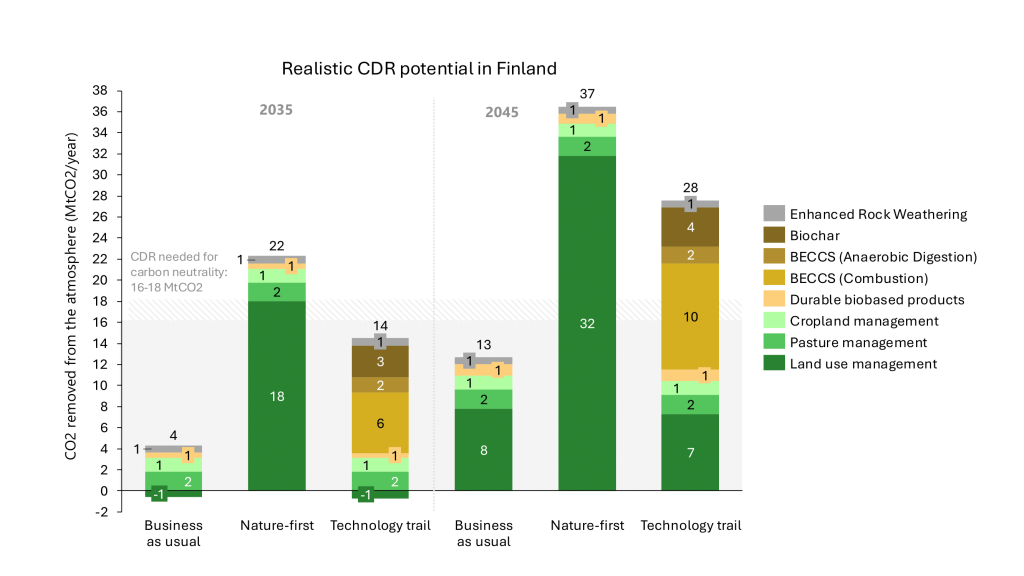
Business as usual in the forests (path A1): Harvesting remains high, and nature alone is asked to shoulder the burden. The result? Finland misses its neutrality goal in both 2035 and 2050. Forests, overworked by the high harvesting levels, are a net source of emissions, and novel CDR technologies are not developed.
The nature‑first route (path A2): Finland lowers forest harvesting and leans heavily on nature-based solutions. By 2035, forests, soils, and ecosystems remove 22 million tonnes of CO2 annually, enough to meet the neutrality target. By 2050, the sink grows stronger, pulling 37 million tonnes each year. Highly permanent removals are not developed.
The technology trail (path B): Novel CDR methods such as BECCS and biochar blend with land use management. By 2050, this path could remove 28 million tonnes annually. It doesn’t quite deliver neutrality by 2035, but it aligns with Finland’s industrial needs. The catch? It demands rapid investment, new infrastructure, and secure CO2 storage.
Choices matter
The illustrative scenarios reveal a truth – forest harvesting decisions are pivotal. Finland’s land sector has already shifted from a net sink to a net source. Without sustainable harvesting, even the most advanced technologies won’t be enough.
Every possible future tells us something – forests in Finland are crucial, technology helps, and actions from policymakers, industry associations, and companies today will strongly influence the climate tomorrow. Citizens and stakeholders already cheer for nature‑based solutions, while policymakers begin to see promise in BECCS and biochar.
What emerges is not a choice between nature and technology, but a recognition that Finland’s strongest position comes from pursuing both. Strengthening natural sinks is a must to deliver meaningful removals by 2035, while scaling engineered solutions can add capacity to reach the 2035 goals and lay the foundation for long‑term competitiveness. If Finland restores its land sink and accelerates investment in BECCS, biochar, and other durable removals, it can not only meet its climate commitments but also build the capacity to become a net exporter of high‑quality carbon removals and spearhead the Group of Negative Emitters (GONE). For a country with deep industrial expertise and abundant biomass, this dual‑track approach is a strategic opportunity waiting to be realised.
The turning point
Finland is far from starting at zero in climate action. Its ambitious climate targets, extensive biomass resources, and strong industrial capabilities create a foundation that many countries would envy. The challenge now is to turn these ingredients into a coordinated national effort rather than a collection of promising but isolated initiatives.
The next few years are critical. Finland has a narrow window to build the infrastructure, policies, and cross‑border agreements that will make large‑scale removals possible by 2035. That means accelerating pilot projects, strengthening support for land‑based removals, and laying the groundwork for CO2 transport and international storage. It also means forging a shared national vision so that industry, government, and civil society are rowing in the same direction. As Finland is ahead of the pack, it is in the EU’s interest to ensure its success helping to build trust and momentum in the transition. Close cooperation between the country and the Union will be essential to turn this into a shared success.
As the audience stepped back into the cold Finnish evening, the message was clear: if Finland embraces this opportunity, it can move from climate ambition to climate leadership, and show Europe what a credible, future‑proof carbon removal strategy looks like.