
The MFF, the ECF, and FP10: Decoding the EU’s budget plans and what they mean for CDR
What do the EU’s MFF, Competitiveness Fund, and FP10 mean for carbon removal? Explore funding opportunities, risks, and why stronger support is needed to scale CDR in Europe.
On 16 July 2025, the European Commission unveiled proposals for the EU’s next long-term budget – the Multiannual Financial Framework (MFF) 2028–2034 – along with two major initiatives: a new European Competitiveness Fund (ECF) and a standalone Framework Programme for Research and Innovation (FP10), the successor to the ongoing Horizon Europe.
What is in these proposals, and what could they mean for carbon dioxide removal (CDR)?

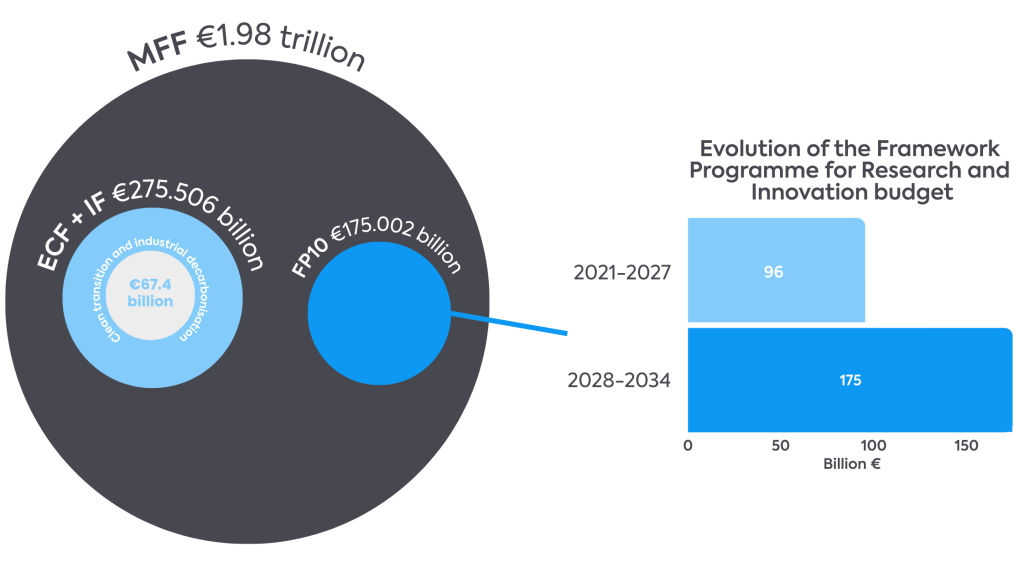
Figure 1: Where the money could be for CDR — breakdown of MFF, Horizon Europe, and Competitiveness Fund proposals. Source: European Commission MFF, ECF, and FP10 proposals
What was proposed – climate & competitiveness
The Commission has proposed a €1.98 trillion MFF (in current prices), equivalent to approximately 1.26% of EU GNI, to shape spending priorities over the period 2028–2034. A 35% spending target is set for climate and environmental objectives.
At the heart of the new funding architecture is a €450.508 billion European Competitiveness Fund, consolidating several existing programmes into one fund aimed at boosting competitiveness in strategic sectors. If we look at new funding sources (not including Horizon Europe which remains an independent though closely linked programme), €275.506 is available, with €67.4 billion earmarked for the clean transition and industrial decarbonisation, including €41.2 billion from the Innovation Fund.
After extensive discussion on its structure, FP10 will remain a standalone R&I programme, though closely linked to the ECF, with a proposed budget of €175 billion. It rests on four pillars: Excellent Science (Pillar I), Competitiveness & Society (Pillar II), with “clean transition and industrial decarbonisation” identified as a core priority under this pillar, Innovation (Pillar III), and the European Research Area (Pillar IV).
In short:
- Without a ringfenced CDR budget, rising inflation, shifting political priorities, and competition from other technologies will erode available funding in practice.
- The loss of the standalone LIFE programme and a dedicated biodiversity budget removes a vital funding pillar for nature-based CDR.
- Stronger alignment between FP10 and the ECF could ensure continuity of support across the full project life cycle.
- The absence of explicit CDR references in the text is politically risky: without recognition, CDR will struggle to compete with more established technologies and risks being sidelined.
- The coming months are make-or-break: CDR needs strategic recognition and sufficient funding now—it cannot afford to wait another seven years.
1. More money – but is it enough?
Nominal increase in the budget masks real-term stagnation, and could lead to the erosion of the share allocated to climate.
The budget envelope has grown, but only very modestly, by a 0.02% increase in the EU GNI share. Additionally, inflation and shifting political priorities () dilute the climate budget in real terms. That said, research and innovation are clear winners, with FP10’s budget growing from €95.5 billion to €175 billion in this new MFF.
What does it mean for CDR?
CDR could benefit from the broader focus on R&I and clean technologies, but, in practice, with no ringfenced budget. Inflation, shifting priorities such as defence and an intense competition for funding across all climate and decarbonisation priorities could shrink the climate budget, including CDR.
2. Budget simplification and mergers: streamlining at a cost
The Commission has proposed merging 52 existing programmes into 16, under four overarching priorities to simplify access to funding — a welcome step, given the complexity of the funding landscape and application processes.
But simplification comes with trade-offs. For example, The LIFE programme, which had a dedicated €5 billion for biodiversity, is effectively absorbed into the ECF. Biodiversity spending is now grouped under broader climate targets — with no specific sub-target or safeguard. Similarly, The Common Agricultural Policy (CAP) is cut by €86 billion and merged into National and Regional Partnership Plans.
What does it mean for CDR?
Nature-based CDR – including marine CDR funding – might be affected. The removal of ringfenced biodiversity funding and the redirection of CAP resources could make it harder for nature-based removal projects to find support — particularly given the competitiveness framing of the ECF, which favours industrial growth. For example, a peatland restoration and carbon sequestration project, previously funded by the LIFE programme, may now have to compete against large-scale industrial decarbonisation projects under the ECF.
3. The clean transition is prioritised, but it’s still a crowded field
The “Clean Transition and Industrial Decarbonisation” window of the ECF is worth €67.4 billion, but it must support a broad range of technologies.
At this high-level stage, proposals remain strategic in nature rather than implementation-ready. However, the absence of CDR from the text is politically dangerous: it risks reinforcing a maturity bias in EU funding that privileges more established technologies such as hydrogen, while sidelining less mature but essential solutions like CDR.
What does it mean for CDR?
Without stronger political commitment and explicit recognition, CDR will struggle to compete in this broad category, risking being overlooked by more mature and favoured technologies. Ensuring CDR is explicitly recognised will be crucial in the next stages of the process.
4. From lab to market: a structural advantage
One clear strength of the proposal is the alignment between FP10 and the ECF. The two programmes are designed to work in tandem — FP10 supporting early-stage R&I, and the ECF providing tools for scale-up and deployment.
What does it mean for CDR
This structural alignment is a positive development. It creates the possibility of a coherent funding pathway from lab to market, something CDR technologies have historically lacked in Europe. Progress should not be staggered because of a lack of continuous support. Yet without explicit mentions of carbon removal in upcoming calls, this pathway risks remaining purely theoretical, leaving CDR without the recognition needed to move from promise to deployment.
What comes next, and why it matters
These are proposals by the EU Commission, not final decisions. They will now enter a period of negotiation between the three EU entities. The Council holds the main role in this process, but the Parliament must also give a vote of consent. Amounts, priorities, and programme structures are likely to change.
Nothing is written in stone, and that’s precisely why this moment matters.
These proposals confirm that clean technologies and innovation are EU priorities. But they also show that competition for funding will be fierce, and that biodiversity and nature-based solutions risk losing visibility in a system now centred on industrial competitiveness.
So, does CDR win or lose? A critical make-or-break moment.
At this stage, the absence of CDR from the documents was expected, but this oversight is not devoid of meaning, and must be looked at carefully. If CDR is not integrated into the next levels of programme design — — then the sector may once again miss out on the support it needs to grow from lab to scale.
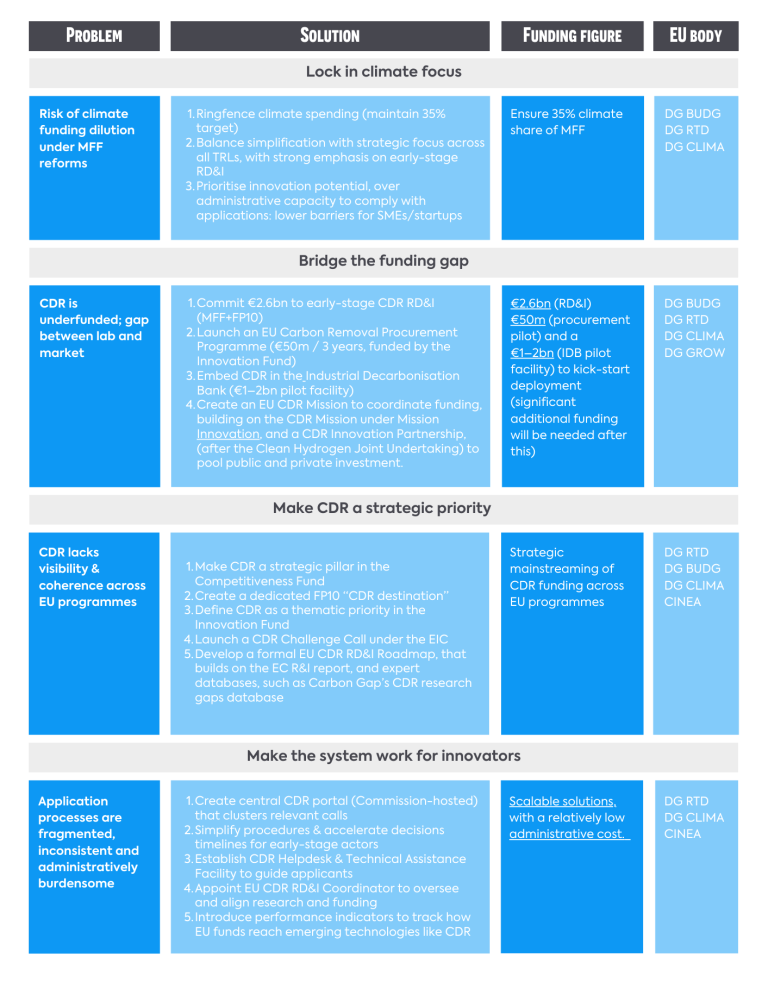
Source: Carbon Gap’s funding report, MFF public consultation response
The foundations are there but without action, they won’t be enough.
The EU has the tools, the frameworks, and the ambition. What it needs now is follow-through. CDR must be strategically recognised, structurally supported, and operationally funded — or Europe risks leaving a key part of its climate neutrality puzzle unsolved.
Now is the moment to act — and ensure carbon removal has a future in Europe.