
How to avoid carbon removal delaying emissions reductions
We examine how to avoid carbon removal delaying emissions reductions - 12 solutions to mitigation deterrence
With global carbon budgets shrinking rapidly, carbon removal strategies have become an essential component of reaching net zero emissions and stabilising rising temperatures. However, concerns persist within the climate policy community that reliance on future carbon removal deployment could deter or delay urgent efforts to cut emissions in the near term. This phenomenon, known as ‘mitigation deterrence’ or ‘moral hazard,’ poses risks of overshooting carbon budgets if emissions reductions are reduced today based on assumptions about large-scale availability of carbon removal technologies in the future.
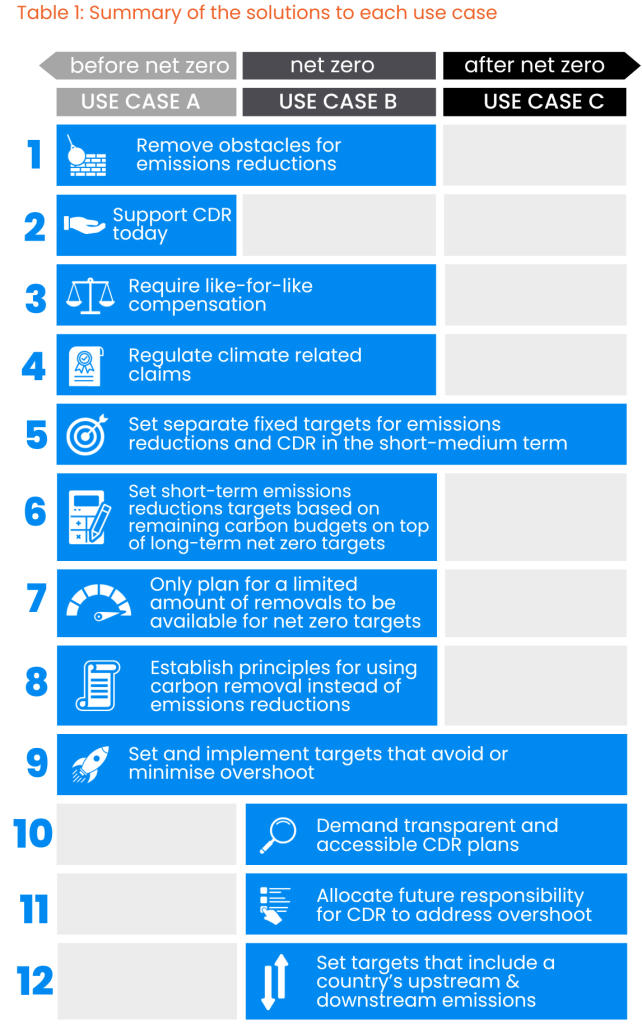
This report aims to enable policy-makers and practitioners to responsibly accelerate carbon removal deployment while avoiding mitigation deterrence risks. It provides a comprehensive framework for understanding and proactively addressing potential mitigation deterrence across three key use cases of carbon removal as defined by the IPCC. Based on this analysis, tailored solutions are proposed to remove the factors encouraging mitigation deterrence and establish the guardrails needed to limit its impact.
Accelerating progress towards net zero
The first use case examines deploying carbon removal to complement aggressive emissions reductions in accelerating progress towards reaching net zero targets. With current climate action lagging, carbon removal deployment must begin immediately in order to have time to scale up to the massive gigatonne levels needed by mid-century. Starting deployment now also reduces risks of carbon removal solutions failing to materialise at scale or underperforming expectations.
Removing obstacles to emissions reductions through incentives, infrastructure, and regulations is a key starting point to avoiding mitigation deterrence. However, safeguards are also essential in the near-term to avoid mitigation deterrence, given the remaining uncertainty about carbon removal technologies. The report highlights the like-for-like principle where only permanent carbon storage can be used to neutralise fossil fuel emissions. Doing so avoids the risk of deterring fossil fuel phase-outs by relying on low-permanence biogenic storage.
In addition, the report advises instituting separate, fixed interim targets for emissions reductions and carbon removal ramp-up. These targets would prevent carbon removal deployment from displacing ambitious reductions.
Reaching net zero
The second use case for carbon removal covers deploying carbon removal to neutralise residual emissions and sustain a durable net zero state with the minimum level of overshoot.
The report highlights the importance of planning for net zero using conservative assumptions on the availability of carbon dioxide removal and advises setting short-term emissions reductions targets aligned with remaining carbon budgets to complement long-term net zero goals to avoid backloading mitigation.
The report also proposes developing clear principles to determine when carbon removal may be deployed instead of further emissions reductions efforts. This optimisation should weigh the costs, negative impacts, and feasibility constraints of both options.
Enabling net negative emissions
The third use case involves planning to use future carbon removal technologies to achieve net negative emissions and lowering temperatures after overshooting 1.5C or 2C climate goals. The theoretical availability of negative emissions to compensate for overshoot could deter the radical near-term emissions reductions required to avoid overshooting carbon budgets in the first place.
Several factors determine whether mitigation deterrence is occurring in relation to overshoot for a given country. These include the feasibility of further emissions reductions under current conditions, a country’s interpretation of their fair share of global effort, and their overall commitment to climate goals.
Although few countries explicitly plan to overshoot their fair share of the carbon budget, many could be said to implicitly do so. Countries without plans for near-term emissions cuts could be said to be particularly exposed to mitigation deterrence, and they provide particular cause for concern. Countries that already have 1.5C-compliant emissions reductions targets that are not overly reliant on CDR could be said to not be mitigation deterred.
The report puts forward solutions to avoid mitigation deterrence related to overshoot. Firstly, urging countries to set binding near-term targets consistent with 1.5C carbon budgets and rapid mitigation is paramount. Any references to negative emissions solutions should also prompt demands for detailed roadmaps demonstrating feasibility and alignment with the like-for-like principle. Quantitatively allocating future negative emissions responsibilities across countries would also sharpen incentives for ambitious targets today. The last proposed solution is to make countries set targets for all of the emissions for which they are responsible, including their consumption-based emissions and the emissions from the export of fossil fuels, for example.
Other types of mitigation deterrence
In addition to the policy-driven mitigation deterrence forms covered in the three use cases, the report acknowledges a more indirect discourse driven form of deterrence. Portraying removal as a ‘silver bullet’’ solution risks creating complacency and a justification for climate inaction. While this indirect deterrence risk is difficult to quantify, the solutions proposed in the report would significantly limit its impacts.
In summary, this report’s proposed solutions enable decision-makers to responsibly scale up removal while maintaining urgency on emissions reductions and avoiding a harmful tradeoff.