Germany’s race to build a carbon‑removal nation
Our blog looks at the recent Germany CRRA report and roadmap launch and what it means for the country's climate policy progress.
Last month at the Impact Hub in Berlin, researchers, NGOs, policymakers, startups, and industry leaders – many of the sharpest minds in Germany’s carbon‑removal ecosystem – came together for the launch of the Carbon Removal Readiness Assessment (CRRA) for Germany and its accompanying national roadmap.
With key input from Julia Pongratz, Felix Schenuit, Katharina Fey, Nadine Saken-Walsh, and Patricia Toth, the room was filled with a sense of urgency and possibility. As one participant put it, “the credibility of net-zero depends on CDR starting to deliver as soon as possible.”
Germany is now better positioned than most countries to make that happen – and even to become a frontrunner on the path to net‑zero. Under its climate law, Germany must reach net‑zero emissions by 2045 and net‑negative emissions thereafter. Even with ambitious mitigation, the country will still face 45–80 MtCO₂ of residual emissions in 2045 from sectors like steel, cement, waste, agriculture, and aviation.
The CRRA study shows that Germany can rise to this challenge. With the right policies and infrastructure, it could deploy a diversified portfolio of carbon removal methods and achieve more than 95 MtCO₂ of removals per year by 2045.
That would be enough to neutralise residual emissions, hit the net‑zero target on time (or even earlier), and begin the shift to net‑negative emissions. But only if Germany accelerates fast.
CDR illustrative scenarios: what is actually possible in Germany to reach net-zero by 2045?
To understand how much carbon removal Germany can realistically deliver, the CRRA assessment models three scenarios for 2035 and 2045. All of them start from the same physical foundation – mapping resources such as land, biomass, renewable energy, and storage capacity – but they diverge based on political choices, resource allocation, and infrastructure readiness.
Scenario A, the low‑ambition pathway, looks a lot like today (status quo). Limited storage development and competing uses for biomass keep removals modest: around 26 MtCO₂ in 2035 and 47 MtCO₂ in 2045, with natural forest sinks doing a lot of the work. BECCS and DACCS barely scale because the CO₂ storage simply isn’t there.
The two high‑ambition scenarios: Scenario B (energy‑efficiency focused) and Scenario C (reduced BECCS) show what becomes possible with stronger policy action. Both reach ~42 MtCO₂ by 2035, but by 2045 they climb to ~91 MtCO₂ (Scenario B) and ~95 MtCO₂ (Scenario C). The difference comes down to political preference: Scenario C deliberately limits BECCS and shifts storage capacity toward DACCS, while Scenario B leans more heavily on biomass.
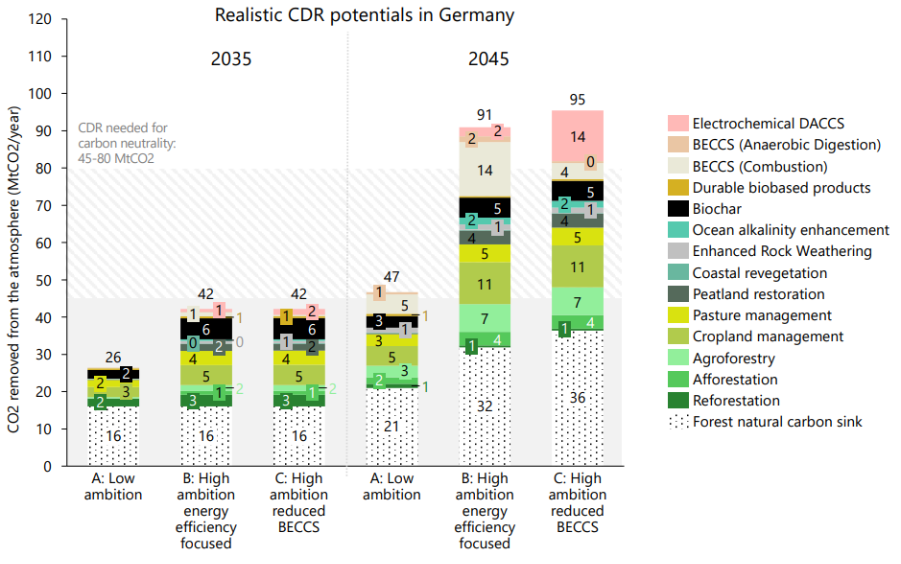
Across all scenarios, one conclusion stands out: Germany can reach 90+ MtCO₂ of removals by 2045 – but only if it builds CO₂ storage and commits to scaling CDR now.
The three pillars to advance CDR in Germany
The CRRA roadmap outlines three pillars that must advance in parallel.
1. Build the policy architecture
What emerged clearly in Berlin is just how far Germany’s CDR ecosystem has already come. Researchers spoke about projects entering their second and third phases. Officials hinted that the national CDR strategy – the LNe – is finally close to publication. Even NGOs like NABU are now engaging constructively with permanent removals, and the Deutscher Verband für negative Emissionen e.V. (DVNE) is working to create demand across both temporary and durable CDR.
And yet, despite this momentum, the mood in the room wasn’t triumphant. It was almost impatient. Stakeholders know Germany is ahead of many countries, but they also know that progress alone isn’t enough. They want clearer rules, stronger governance, and faster action.
That’s exactly what the CRRA roadmap calls for: a Long‑Term Strategy for Negative Emissions, harmonised MRV and sustainability standards, a recurring CDR coordination cycle, and a public narrative that explains why carbon removal is essential to protecting nature and stabilising temperatures.
Germany has the ingredients. Now it needs the architecture to bring them together.
2. Scale pilots and early deployment
One message kept resurfacing: Germany now needs to move from research to reality. The roadmap makes this shift concrete. It calls for a technology‑neutral pilot programme to get early projects off the ground, paired with public procurement to give developers the confidence to build. It also recommends de‑risking tools for first‑of‑a‑kind facilities – because without early support, many promising ideas will never leave the lab.
But the real hinge point is infrastructure. Everyone in the room agreed: without CO₂ transport and, above all, storage, engineered removals simply cannot scale. Germany will need a mix of domestic storage options and cross‑border access to North Sea hubs if it wants to reach meaningful volumes.
3. Build a market that lasts
Pilots alone won’t deliver the tens of millions of tonnes Germany will need by the 2030s. At some point, the country must shift from experimentation to regular business. That means creating durable demand mechanisms, standardising contracts and registries, and linking into European CO₂ networks so projects can operate at scale.
This is the moment when scattered initiatives become a real market capable of delivering reliable, high‑integrity removals year after year.
A narrow window, a historic opportunity
As the discussions in Berlin made clear, Germany now stands at a crossroads. The country has the talent, the science, the industry, and the momentum – but it also has a rapidly closing window: to reach 95 MtCO₂ of removals by 2045, action can’t wait.
The next decade will be decisive. By 2030, Germany needs to publish the LNe, launch procurement, back its first wave of projects, and secure reliable CO₂ storage pathways. By 2035, those early successes must scale, with CO₂ infrastructure fully operational. And by 2045, the country must be delivering durable, multi‑megaton removals, enough to hit net-zero and begin the shift to net‑negative emissions.
If Germany succeeds, the payoff is enormous: meeting its climate targets, anchoring a new industrial sector, exporting world‑class technologies, and strengthening Europe’s climate leadership while reinforcing the credibility of net-zero.
The message from Berlin was unmistakable. Germany can lead Europe into the age of carbon removal – if it chooses to build the systems, markets, and public trust needed to get there.
And after the launch event last month, surrounded by a room full of brilliant, committed people, it was hard not to feel that this future is within reach.