A Carbon Carol: Buildings of the Past, Present, and Future
Using timber in buildings has significant carbon removal potential, but there is still a lot of uncertainty around longevity and sustainability. We dive in to how timber has been used in the past and how it can pave way for a net-negative future.
The time between Halloween and Christmas, when the trees turn to ghostly skeletons, and there’s a crispness in the air, is a perfect time to combine the best of both holidays: ghosts and Christmas cheer. I therefore bring you the tale of Ebony-zer and the Ghosts of Buildings Past, Present, and Future, a story of hope and how any wood, like Ebony-zer, could store carbon and preserve it for decades and even centuries.
For those of you unfamiliar with Charles Dickens’ A Christmas Carol, Ebenezer Scrooge is a grumpy miser who cares for nothing but money until he is visited by the ghosts of Christmas past, present, and future who show him the error of his ways. Reformed, he vows to be generous and think of others. Of course, I do not mean to belittle the current climate crisis by comparing our global predicament to a 19th century pre-industrial novel aimed at highlighting the woes of capitalism, but the narrative arc of the protagonist provides a useful template with which to compare our past circumstances with those of our present and what we hope could be our future.
I recognise that ebony is not necessarily a wood used for timber construction, but I ask you to humour my pun as a storytelling element really meant to kindle (get it?) your interest in what could otherwise just be dead wood (pun intended). So, puns aside, allow me to take you on a journey of construction past, emissions present, and net-negative future.
Part 1 – The Ghost of Buildings Past
Our story starts with the building of the cathedral of Notre Dame de Paris, beginning in 1163. Back then, timber was the building material of choice, with stone reserved for more important buildings, although these buildings still used timber as an important structural element, notably for the roof. Timber for such an important building was sourced from the strongest oaks and used to build the massive “forest” of beams and trusses that formed the cathedral’s roof. Most importantly for this story, the carbon retained in those trees felled so long ago was stored for centuries in the building, much longer than it would have been if left in the forest.
As illustrated by the pre-2019 Notre Dame, timber can have significant potential as a “long-lived product” – a way of durably storing carbon for decades. Trees naturally sequester carbon, but that carbon is then released back into the atmosphere when the tree dies. There are no readily available calculations for how much carbon was or is now stored in Notre Dame, but if designed well, the carbon density of timber buildings can even surpass that of soil and trees, even for a mid-rise city. Scientists have calculated that a single building can store up to 0.01–0.68 GtC per year.
But as we saw in 2019 when the whole cathedral burned, timber has its downsides. It’s notoriously flammable. Not only that, but it also expands and contracts based on humidity, and its grain structure and strength can be inconsistent. For these reasons, timber was ditched in favour of concrete and steel in the 19th century. These new materials allowed us to build larger, stronger, and less flammable buildings.
Yet as we know, the efficiency of these materials came at a cost. Today, the construction industry is responsible for 37% of global emissions, due largely to the emissions of heating and calcinating lime to make cement, and the coal-derived coke used to make steel, not to mention emissions around mining and transporting iron ore. Concrete now accounts for 70% of all building materials; yet timber’s share of the market is growing, partly because of growing concerns around the carbon footprint of conventional concrete and steel and growing demand for construction methods that are more cost-efficient yet durable.
But there are many factors that will affect the growth of timber as building material, most notably, natural constraints on forests. Europe’s land sink is declining and as climate change ramps up, forests are becoming increasingly fragile, at risk from worsening droughts, storms, and forest fires; storing the carbon they produce in buildings, more sheltered from the whims of climate change, could compensate for the carbon released through natural disasters. But then again, fires in buildings will also increase. A look at the 16,000 structures destroyed in the recent Los Angeles fire says it all.
But there is hope. We can use buildings to store carbon for centuries, and by sustainably managing our forests, reorienting market demand, updating building codes and creating robust regulation around crediting “long-lived products”, there is a chance we could grow both our land and city carbon sinks.
And so, we’ve arrived at the Ghost of Buildings Present.
Part 2 – the Ghost of Buildings Present
The tale of Ebony-zer and the Ghost of Buildings Past (see Part 1) recounts of a shift from timber in favour of concrete and steel, and with it, from storing to emitting carbon. That brings us to the Ghost of Buildings Present, a time when we understand the carbon footprint of the building sector and are working to address it.
There are many startups working on mitigating the sector’s emissions. Some are using software to better calculate building needs and cut waste, others have developed carbon-negative concrete. But there is also a notable move back to timber, with a projected compound annual growth rate (CAGR) of 6.0% from 2022 to 2031. Timber is regaining popularity, especially since the carbon storage potential of bio-based products remains much higher than that of concrete (Figure 1).
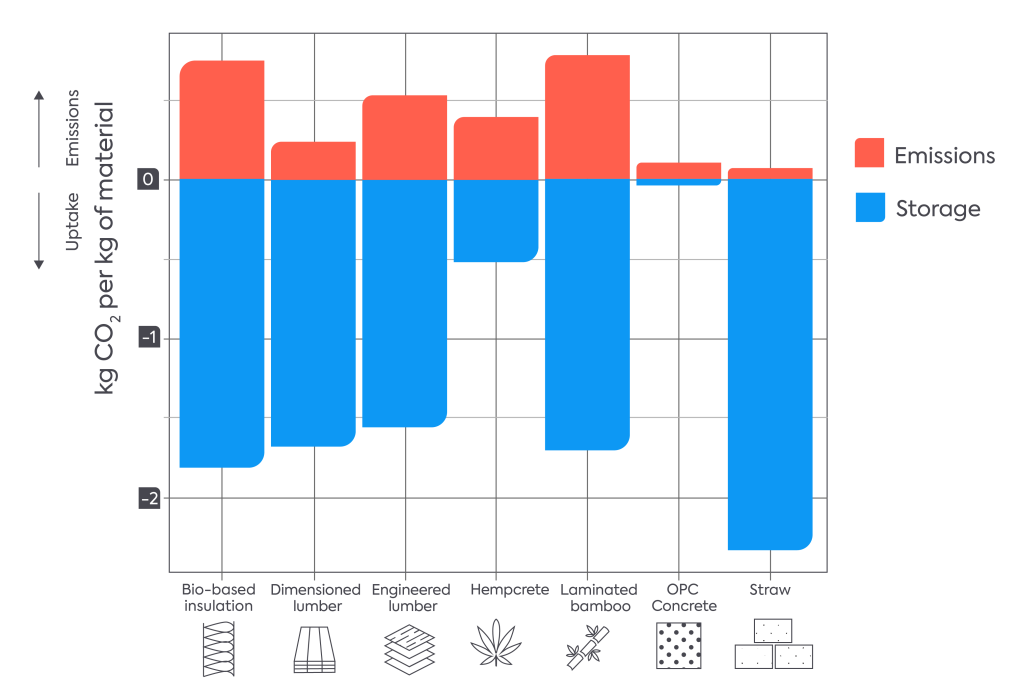
Figure 1: Net Carbon-Storage Potential of Building Materials. Adapted from Pomponi et al. 2020.
That’s not to say there are no emissions involved in using timber. The cost and emissions of growing and felling trees, sawing, milling, drying, transporting, and constructing are not negligible, not to mention the potential of deforestation. The decision to topple 230-year-old trees and place them in Notre Dame’s new roof structure was not without controversy. Although the 1000 oaks felled in the project represent just a small portion of annual timber harvests coming from sustainably managed forests, the controversy does speak to legitimate concerns about the current state of our natural land sinks. There is a clear imbalance in supply and demand – more timber is needed than forests can produce. On top of that, around the world, most future construction will be in areas that have the type of timber we want to preserve.
But forests will need to keep up with higher demand. For most countries, large timber production is not possible, but faster-growing products like bamboo and grasses have greater yields and can be explored as alternatives, not only for structure, but also in panelling and insulation. These materials have varying levels of carbon storage potential (Figure 1), and, unlike most forests that take decades to mature, bamboo can be harvested after only seven years. Bamboo also has a high strength-to-weight ratio that can perform better than conventional brick, offering a viable alternative to traditional timber.
It’s not only a question of alternative forms of timber; it’s also about re-orienting the market for bio-based products away from short-term products (such as paper and fuel for energy) and more toward long-lived products (like structural timber). In many countries, France being one, energy use from biomass has largely been subsidised, and political support would need to shift toward supporting long-term products instead, as Germany has done. Boosting the manufacturing of wood-based panels and biomass insulation could be an effective short-term measure to direct more wood towards long-life uses in the short term without increasing harvests.
Increasing timber construction and with it the carbon storage potential of buildings, however, must not be done at the expense of our natural sinks. Mitigating the risk of deforestation and emissions from timber building and harvesting will depend on robust, sustainable forest management and monitoring. If trees are felled and not replaced, then using timber to build is simply a highly inefficient form of moving carbon from forests into cities, thereby making the whole process net-neutral at best. Political and legal commitment to sustainable forest management, robust forest certification schemes, greater community empowerment of adjacent communities, and efforts to curb illegal logging could go a long way toward making sure that harvesting remains net-negative. A good example of sustainable forest management comes from Sweden, where each tree felled was replaced by two, with the end result that the country doubled its forests in less than 100 years.
As we step back from the picture painted by the Ghost of Buildings Present, we see that we are at an inflection point. We are starting to move away from CO2-intensive construction materials, but we must tread carefully to preserve both the sustainability of our landsinks, and that of our cities. As we deal with ever-increasing demand for housing, we can orient that demand toward bio-based buildings. But we must couple that move with stronger regulation and forest management to ensure that we truly shift toward a more sustainable and carbon-negative building sector.
And with that, we look ahead at the Ghost of Buildings Future.
Part 3 – the Ghost of Buildings Future
In the first two parts of our story, Ebony-zer visits the Ghosts of Building Past (Part 1), where timber was historically one of the primary building materials and was phased out for the greater efficiency and strength of concrete and steel. But as we grapple with the sector’s emissions, we have an opportunity to improve upon historic building methods and use new sources of biomaterials (Part 2) to make the sector carbon neutral, even (dare I say it) carbon negative.
Looking to the future, construction techniques have come a long way since the Industrial Revolution’s shift away from timber, and we have made major advances in structural integrity through laminated and cross-laminated timber, along with advances in fireproofing. The Mjøstårnet skyscraper in Norway is a promising example of what can be done with this material. Engineers used glulam to reinforce timber’s natural fire resistance, and the building broke records for timber-building floor area and height. Wood is lighter than steel or concrete, so buildings often require smaller foundations and less energy- and emissions-intensive concrete, offering a viable option for decarbonising the construction industry.
But it’s not just about building new. The greenest building is the one that already exists. Around 80% of the world’s buildings will still be here in 2050 and retrofitting an existing building emits 50%-75% less carbon compared to building new. Notre Dame stands a relevant, if grandiose, example of old technology made new. The building has been reconstructed using the same strong oak timber, but fitted with retardant technology to ensure the cathedral stands (and stores carbon) for another few centuries.
Similarly to the cathedral, retrofitted and newly built structures will need to be designed with longevity in mind, and building codes will need to be updated. Making sure our timber buildings are designed to encourage the reuse or recycling of the timber and then collecting timber from demolished buildings could prolong the potential for long-term carbon storage. Increasing timber construction will also require retraining the construction workforce and expanding timber manufacturing capacity. Many current building codes restrict the size of timber buildings for fire safety, but building codes need to reflect differences in fire behaviour with more tailored fire testing and rescue standards.
Boosting the use of wood products also has cultural co-benefits. Reinforcing sustainable forestry can empower forest-adjacent communities and boost traditional forestry practices. Indigenous communities have sustainable practices we can learn from; some, like the Native-American practice of controlled burning in the US, are being revitalised. A renewed focus on timber framing can also reignite traditional building practices that have been overlooked for newer, sleeker designs and help align modern developments with historical and cultural contexts. Here again, we turn back to Notre Dame, which called on 60 artisans from across seven countries for the reconstruction of the roof. Adapting and revitalising timber-framed buildings could help revitalise these traditional crafts.
The EU has acknowledged the need to grow the timber construction industry, notably through the LULUCF (Land Use, Land-Use Change, and Forestry) which aims to address the EU’s shrinking forest carbon sink, and the Ecodesign for Sustainable Products Regulation (ESPR) which aims to regulate the sustainability of products, among them timber used in construction. However, there is no current overarching policy that incentivises the use of bio-based products in construction.
Most of the current demand for “long-lived products” instead is largely based on the voluntary carbon market, where the amount of carbon stored can be sold as a “carbon removal units”. The EU Carbon Removal and Carbon Farming (CRCF) Regulation standardises these units and defines the minimum criteria for storing carbon in timber buildings as a minimum of 35 years. This threshold has been criticised as too low by many experts, leading other certification bodies, like Puro, to require 100 years for accreditation in alignment with IPCC inventory and reporting time horizons. As the Commission plans to roll out these credits, it is drafting a methodology for certification, but its proposed methodology faces hurdles, especially around additionality, that is, how can we prove that using timber removes additional carbon than the building otherwise would. More importantly, however, is that the credits under the CRCF remain voluntary and more will need to be done to boost the market for timber-based products, including updating building codes to reflect technological advances, developing deployment incentives to boost demand for these products, and establishing more rigorous forest monitoring to ensure sustainable management of EU land sinks.
The Ghost of Buildings Future has shown us what sustainably managed forestry and construction could look like in the EU, but we are not there yet. With the right mix of policy and demand, we can revive one of our oldest building materials to store carbon for decades and even centuries, a move that could see a total CO2-reduction of 18% (37 Mton) in 2030 if 50% of new residential construction is bio-based. With modern building techniques and new fireproofing technologies, Mjøstårnet and now Notre Dame stand as examples of how our cities could be rebuilt in timber. With climate change increasingly threatening our forests, cities give us the opportunity to preserve some of that natural carbon in a way that can revive traditional industries, incentivise sustainability, and most importantly, make our cities carbon negative.