Event:16 September | Carbon Removal Policy Summit

A new reference from Carbon Gap

Foundations of
Carbon Removal

A practical reference for policy, markets and implementation.

Understand the system, compare policy options and work through the practical choices that shape deployment.

Expected late 2026 / early 2027
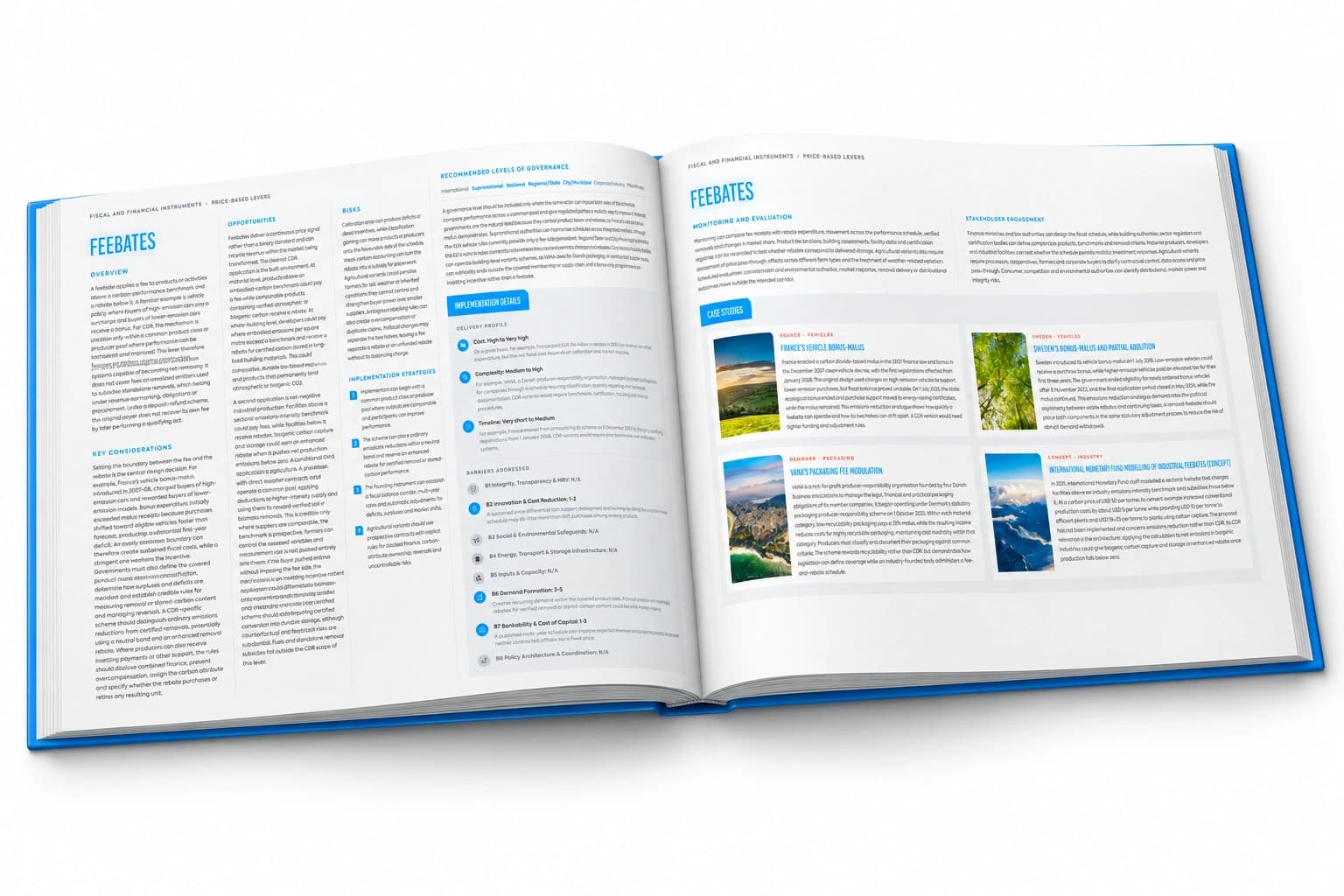
Open-book design concept based on the Feebates sample, showing the reference’s landscape page layout.
Book design concept. Final design and layout pending.
  • Free PDF will be available
  • Physical edition planned

24CDR approaches

160+Policy levers

300+Visuals

20+Digital tools

Inside the book

Contents

  1. What Is Carbon Removal?

    Definitions, boundaries and the role of removal alongside emissions reductions.

  2. The Case for Carbon Removal

    The climate, economic and political reasons to build removal capacity.

  3. Principles for Carbon Removal Policy

    Twenty principles for the choices that shape carbon removal.

  4. The Carbon Removal Portfolio

    Twenty-four approaches, their mechanisms, characteristics and trade-offs.

  5. Carbon Removal in the Real Economy

    Connections to economic sectors, deployment geography and carbon storage.

  6. Markets, Finance and Bankability

    How costs, revenue, risk and demand shape viable projects and markets.

  7. Integrity, Accounting and Trust

    What makes removals credible, measurable and responsibly governed.

  8. Barriers to Deployment

    Eight barriers and how they change across approaches and over time.

  9. The Policy Levers Library

    A structured reference to policy instruments, design choices and implementation.

  10. Choosing and Combining Policy Levers

    Matching and sequencing instruments by actors, bottlenecks, risks and timing.

  11. Routes to Scale

    Illustrative scenarios showing how different policy packages could work.

  12. From Strategy to Implementation

    Responsibilities, institutions and practical steps for delivering a strategy.

  13. Further Reading and Data Resources

    Reports, datasets and organisations for deeper exploration.

From understanding the field
to putting it into practice.

Carbon removal in the real world

Twenty-four approaches explained through the activities, facilities and processes that deliver removal.

Principles for better policy

Twenty principles connecting industrial policy, finance, infrastructure and climate governance.

The Policy Levers Library

Policy instruments with design guidance, implementation considerations and real-world examples.

Economics, integrity and barriers

How the removal economy works, what makes removals credible and the eight barriers to deployment.

Tools for implementation

Decision frameworks, worked scenarios, checklists and templates to turn analysis into action.

Visuals and evidence you can use

More than three hundred visuals to explain the choices and support practical policy discussions.

Closer to implementation

Carbon removal,
at the site level.

See how removal works in forests, farms, treatment plants and industrial facilities, and what implementing each approach involves. This brings the analysis closer to the practical decisions facing policymakers and project developers.

24 approachesDrag or swipe to explore

Readiness
High
Storage duration
Decades to centuries
Reversal risk
High
Readiness
High
Storage duration
Centuries to millennia
Reversal risk
High
Readiness
High
Storage duration
Decades to centuries
Reversal risk
High
Readiness
High
Storage duration
Decades to centuries
Reversal risk
High
Readiness
High
Storage duration
Decades to centuries*
Reversal risk
High
Readiness
Moderate
Storage duration
Centuries to millennia
Reversal risk
Low
Readiness
Moderate
Storage duration
Centuries to millennia
Reversal risk
Low
Readiness
Moderate
Storage duration
Centuries to millennia
Reversal risk
Low
Readiness
Moderate
Storage duration
Centuries to millennia
Reversal risk
Low
Readiness
Moderate
Storage duration
10,000+ years
Reversal risk
Negligible
Readiness
Moderate
Storage duration
10,000+ years
Reversal risk
Negligible
Readiness
Moderate
Storage duration
Decades to centuries
Reversal risk
Moderate
Readiness
Moderate
Storage duration
10,000+ years
Reversal risk
Negligible
Readiness
Low
Storage duration
10,000+ years
Reversal risk
Negligible
Readiness
High
Storage duration
Decades to centuries
Reversal risk
Moderate
Readiness
High
Storage duration
Centuries to millennia
Reversal risk
Low
Readiness
Low
Storage duration
Decades to centuries
Reversal risk
Moderate
Readiness
Low
Storage duration
Decades to centuries
Reversal risk
Moderate
Readiness
Moderate
Storage duration
10,000+ years
Reversal risk
Negligible
Readiness
Moderate
Storage duration
Centuries to millennia
Reversal risk
Low
Readiness
Moderate
Storage duration
10,000+ years
Reversal risk
Negligible
Readiness
Moderate
Storage duration
10,000+ years
Reversal risk
Negligible
Readiness
Moderate
Storage duration
10,000+ years
Reversal risk
Negligible
Readiness
Moderate
Storage duration
10,000+ years
Reversal risk
Negligible

A common framework

Address all eight
barriers in parallel

The book assesses CDR approaches and policy levers against eight shared barriers, linking what holds deployment back to the interventions that can help.

  • Integrity, Transparency & MRV

    Establish credible monitoring, reporting and verification, with transparent evidence of the climate impact of removals.

  • Innovation & Cost Reduction

    Advance removal methods and bring down costs through research, demonstration and learning from deployment.

  • Social & Environmental Safeguards

    Protect people and ecosystems, address local impacts and build trust in how projects are developed.

  • Energy, Transport & Storage Infrastructure

    Coordinate access to clean energy and the transport and storage networks that projects depend on.

  • Inputs & Capacity

    Secure sustainable feedstocks, equipment, skills and the capacity needed to build and operate projects.

  • Demand Formation

    Create reliable demand for removals, with buyers willing and able to commit to purchases.

  • Bankability and Cost of Capital

    Make projects investable through credible revenues, manageable risks and affordable finance.

  • Policy Architecture & Coordination

    Align rules, institutions and responsibilities so policy supports delivery across sectors and levels of government.

Inside the analysis

See the decisions.
Understand the trade-offs.

More than 300 visuals, including tables, charts, diagrams and case studies, throughout the book.

Finance and bankability

How interest rates and repayment periods affect cash available after debt service.

Integrity safeguards

How safeguards reduce the likelihood of integrity failures, their consequences, or both.

Project economics

How the cost of capital and utilisation affect lifetime cost per tonne.

Demand and market formation

How financeable commitments, clear signals and shared learning support market formation.

The digital companion

A reference to read.
Tools to work with.

More than twenty planned digital tools will help readers explore assumptions, compare options and work through decisions.

*Companion tools still in development. Preview does not represent final content design or functionality.

Who it’s for

For the people
putting removal
into practice.

Policymakers, public officials, businesses, investors, researchers and advocates.

Whether you are entering the field or working through a specific implementation challenge, the book helps you find what you need and put it to use.

Publication & access

Digital edition
A free PDF is planned.
Physical edition
Print is planned. Price, ordering and delivery details will follow.
Expected publication
Late 2026 / early 2027.

Stay in the loop

Be first to hear
when it is ready.

Join the waiting list for publication news and availability updates about Foundations of Carbon Removal.

Expected late 2026 / early 2027

The book is in development. Registering interest is not a purchase or a pre-order.

Inside the book